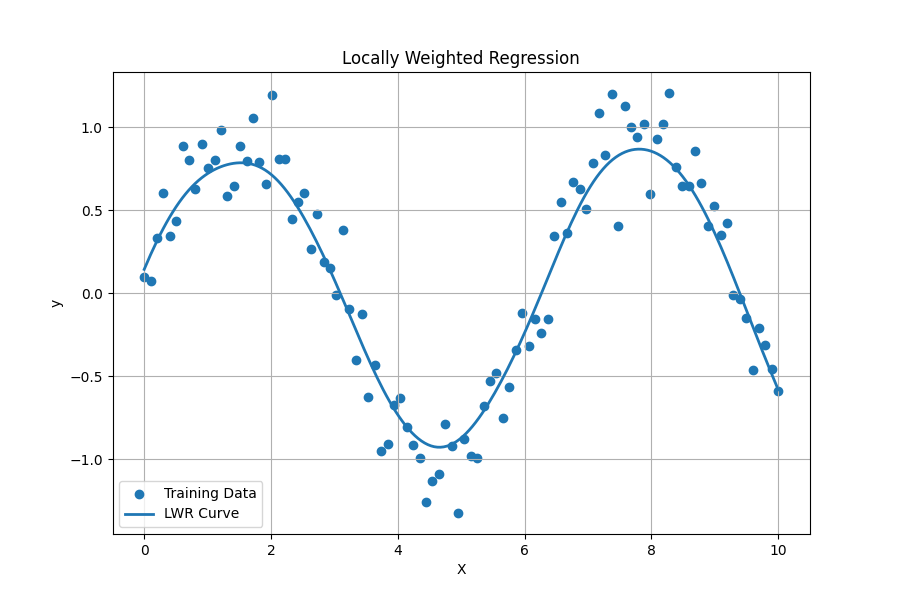
5. Implement the non-parametric Locally Weighted Regression algorithm in order to fit data points. Select appropriate data set for your experiment and draw graphs.
PROGRAM:
#install required packages
#pip install numpy matplotlib

import numpy as np
import matplotlib.pyplot as plt

# ==============================
# 1. Create Dataset
# ==============================
np.random.seed(42)

X = np.linspace(0, 10, 100)
y = np.sin(X) + np.random.normal(0, 0.2, 100)

# ==============================
# 2. Locally Weighted Regression
# ==============================
def kernel(x, x_i, tau):
    return np.exp(-((x - x_i) ** 2) / (2 * tau ** 2))


def locally_weighted_regression(X, y, query_point, tau):
    m = len(X)

    X_bias = np.c_[np.ones(m), X]
    query_bias = np.array([1, query_point])

    weights = np.zeros((m, m))

    for i in range(m):
        weights[i, i] = kernel(query_point, X[i], tau)

    theta = np.linalg.pinv(X_bias.T @ weights @ X_bias) @ X_bias.T @ weights @ y

    prediction = query_bias @ theta

    return prediction


# ==============================
# 3. Predict Values
# ==============================
tau = 0.5

X_test = np.linspace(0, 10, 200)
y_pred = []

for x in X_test:
    y_pred.append(locally_weighted_regression(X, y, x, tau))

y_pred = np.array(y_pred)

# ==============================
# 4. Plot Graph
# ==============================
plt.figure(figsize=(9, 6))

plt.scatter(X, y, label="Training Data")
plt.plot(X_test, y_pred, label="LWR Curve", linewidth=2)

plt.title("Locally Weighted Regression")
plt.xlabel("X")
plt.ylabel("y")
plt.legend()
plt.grid(True)

plt.show()OUTPUT: